The Department of Defense POW/Missing Personnel Office announced today that the remains of a serviceman, missing in action from World War II, have been identified and are being returned to his family for burial with full military honors.
Army Sgt. Edward T. Jones, of West Pawlet, Vt., will be buried on Sept. 25 in Saratoga, N.Y. In November 1944, the 112th Infantry Regiment, 28th Infantry Division was traveling east through the Hürtgen Forest in an attempt to capture the German towns of Vossenack and Schmidt. On Nov. 6, Jones and five other members of A Company, 112th Infantry Regiment, were killed in the town of Kommerscheidt when a German tank fired point-blank on their position.
In 2008, a German explosive ordnance disposal team, working at a construction site in the town of Kommerscheidt, found fragments of a World War II-era U.S. military boot. The team notified the German War Graves Commission who recovered remains of two individuals at the site and military equipment including two identification tags. The items were turned over to a Joint POW/MIA Accounting Command team in the area for further analysis.
Among other forensic identification tools and circumstantial evidence, scientists from the JPAC used dental comparisons in the identification of the remains.
Friday, September 24, 2010

Tuesday, September 21, 2010
why don't I write more
In case you wonder. Just as an example, today I get a letter from the county saying I have to fill out two ten page forms regarding my mother's estate within a week or get hauled into court. I thought this is why I was paying a lawyer...
Sunday, September 05, 2010
damn jeeps
If someone had walked by with a wad of money yesterday I would have happily sold them my jeep. I had just fixed sonmething on it, and turned out it wasn't really fixed. Some people actually have fun getting greasy and fooling around with car parts. I just want them to work.
I am now thinking what I could do with all the garage space the jeep and all its many associated items are taking up.
I am now thinking what I could do with all the garage space the jeep and all its many associated items are taking up.
Saturday, August 21, 2010
Moths round two
So after fumigating the house, everything was stable for a few days. Then I started to pick up moths on the second floor - which due to the numbers seemed to be coming from my office. A few turned up in the wife's sewing room.
So, I suspect a new genration was hatched after the gas. I then fumigated those rooms and sealed the doors. Now I have to keep watching the pheremone traops to see if a new batch hatches. In theory I should not have to wait more than 10 days for an all clear, but all it takes is one egg laying moth and I have to start all over again.
This is why it is really great to be able to seal off rooms and check them seperatly.
So, I suspect a new genration was hatched after the gas. I then fumigated those rooms and sealed the doors. Now I have to keep watching the pheremone traops to see if a new batch hatches. In theory I should not have to wait more than 10 days for an all clear, but all it takes is one egg laying moth and I have to start all over again.
This is why it is really great to be able to seal off rooms and check them seperatly.
Monday, August 09, 2010
cheaper moth pheremone traps
I normally buy my traps from Insects Limited,
However I just noticed that there are a lot more on the market that seem to be cheaper. Go to Amazon and search "clothes moth trap" and there are a few. I have no idea if these are as good or the same as the IL brand.
I'll have to ask a preservation expert I know. BUt it means not having to buy in amounts of 10.
However I just noticed that there are a lot more on the market that seem to be cheaper. Go to Amazon and search "clothes moth trap" and there are a few. I have no idea if these are as good or the same as the IL brand.
I'll have to ask a preservation expert I know. BUt it means not having to buy in amounts of 10.
At last! A.E.F. photographs.


Just as I finally find a copy of the 950 page WW1 Signal Corps photography caption book, It gets scanned and placed online.
While maybe not of great import to many, this is a major deal to those working with AEF photos. Its now free and avaiable to donload from the internet archives.
I can now keep it on my computer for rapid access, although it is a tad hard to work with as a pdf. However, this was almost the tipping point for my buying a kindle DX to be able to read pdf's on.
The Great Moth war
Using the pheremone moth lures I figured out that the main infestation seems to be coming from my wifes upstairs sewing room. However as most of my collectible wool is in a basement room I hit that right away with some of the yellow no pest strips. Better known as Gulf no pest strips, these slowley release a version of permethrin.
Permethrin is toxic to cats, but not dogs and humans. The permethrin vapor coming off the yellow strips settles to the ground, where most moths live, and acts as a neuro-agent. Its safe to use as long as people, or dogs, don't spedn a lot of time (like sleeping) in the area. Within a day after starting that I picked up no more moths in my basement traps.
I then nuked the house using aresol permethrin spayers. These are cmmonly found in hardware stores, and you seal the house, turn them on, and leave for 2 hours, then come back and ventilate. Now this is going to kill all the living moths, but probably not touch the eggs, which can hatch in a few to ten days. So I am going to have to do it again in 10 days.
One thing I had just never connected with, is that if you have a dog (or cat), they make you more suspectable to clothes moths. They shed and leave hair on the floor. Moths eat wool as it is an animal hair- just like pet fur. So if you have pet fur sitting around under the sofa or whatever, a moth flitting in has a greater chance of finding food for the babies.
And as moths are crappy flyers and like to stay low on the ground, it makes the best preventative measure against them is to vacuum.
Now I feel like I am fighting a guerilla war aginst them.
Permethrin is toxic to cats, but not dogs and humans. The permethrin vapor coming off the yellow strips settles to the ground, where most moths live, and acts as a neuro-agent. Its safe to use as long as people, or dogs, don't spedn a lot of time (like sleeping) in the area. Within a day after starting that I picked up no more moths in my basement traps.
I then nuked the house using aresol permethrin spayers. These are cmmonly found in hardware stores, and you seal the house, turn them on, and leave for 2 hours, then come back and ventilate. Now this is going to kill all the living moths, but probably not touch the eggs, which can hatch in a few to ten days. So I am going to have to do it again in 10 days.
One thing I had just never connected with, is that if you have a dog (or cat), they make you more suspectable to clothes moths. They shed and leave hair on the floor. Moths eat wool as it is an animal hair- just like pet fur. So if you have pet fur sitting around under the sofa or whatever, a moth flitting in has a greater chance of finding food for the babies.
And as moths are crappy flyers and like to stay low on the ground, it makes the best preventative measure against them is to vacuum.
Now I feel like I am fighting a guerilla war aginst them.
Monday, July 26, 2010
more on moths
Well, I spoke too soon. Checking the traps found good numbers (like 10) in both the spare bedrom and wife's sewing room. Which would let me blame her, except I then turned up some in the basement. Thankfully not in the actual collection room, so far.
At this point if it were possible I would bomb the house, but for various reasons I don't really have a place to relocate for a few days and with a small dog you have to be very careful.
So, more pheremone traps everywhere. Try and vacuum as much as possible (this really does help) and I may have to get some DDVP (no pest strips). These slowly give off a toxic gas that sinks to the ground (where moths love to be) and kilsl them The downside is that there is a potential of them causing cancer. Which is why they should only be used in places people don't hang around a lot. Like a sealed basement collection room.
I use them in a large sealed container to fumigate all the wool that enters my collection (is some weird old NASA airtight container I found years ago). But I think now I need to be a bit proactive.
At this point if it were possible I would bomb the house, but for various reasons I don't really have a place to relocate for a few days and with a small dog you have to be very careful.
So, more pheremone traps everywhere. Try and vacuum as much as possible (this really does help) and I may have to get some DDVP (no pest strips). These slowly give off a toxic gas that sinks to the ground (where moths love to be) and kilsl them The downside is that there is a potential of them causing cancer. Which is why they should only be used in places people don't hang around a lot. Like a sealed basement collection room.
I use them in a large sealed container to fumigate all the wool that enters my collection (is some weird old NASA airtight container I found years ago). But I think now I need to be a bit proactive.
Sunday, July 25, 2010
An infestation
Well, it's a moth infestation.
Luckily nothing has shown up on the traps ine the basement where most fo the old wool is. And only one on teh 1st floor (right by the stairway), but 7 male moths on the 2nd floor.
So I am now moving the traps between all the 2nd floor rooms with the doors shut to see if one seems to have a greater number than the rest.
Then I have to figure out the life cycle of the clothing moth so as to make sure I try and nail all the next batch of males before they fertilize the females.
There is somethign to be said for collecting modern stuff- moths do not eat cotton or nylon.
Luckily nothing has shown up on the traps ine the basement where most fo the old wool is. And only one on teh 1st floor (right by the stairway), but 7 male moths on the 2nd floor.
So I am now moving the traps between all the 2nd floor rooms with the doors shut to see if one seems to have a greater number than the rest.
Then I have to figure out the life cycle of the clothing moth so as to make sure I try and nail all the next batch of males before they fertilize the females.
There is somethign to be said for collecting modern stuff- moths do not eat cotton or nylon.
Saturday, July 24, 2010
damn politics
Korean War Battalion Awaits MIA Decision
July 19, 2010
Associated Press
SEOUL, South Korea -- Trapped by two Chinese divisions, troops of the 8th U.S. Cavalry Regiment were left to die in far northern Korea, abandoned by the U.S. command in a Korean War episode viewed as one of the most troubling in American military history.
Sixty years later, those fallen Soldiers, the lost battalion of Unsan, are stranded anew.
North Korea is offering fresh clues to their remains. American teams are ready to re-enter the north to dig for them. But for five years, the U.S. government has refused to work with North Korea to recover the men of Unsan and others among more than 8,000 U.S. missing in action from the 1950-53 war.
Now, under pressure from MIA family groups, the Obama administration is said to be moving slowly to reverse the Bush administration's suspension of the joint recovery program, a step taken in 2005 as the North Korean nuclear crisis dragged on.
"If I had a direct line in to the president, I would say, `Please reinstitute this program. There are families that need closure,' " said Ruth Davis, 61, of Palestine, Texas, whose uncle, Sgt. 1st Class Benny Don Rogers, has been listed as MIA since Chinese attackers overran his company -- I Company, 8th Cavalry -- at Unsan in late 1950.
It was one of Rogers' I Company comrades, Pfc. Philip W. Ackley of Hillsboro, N.H., whose identifying dog tag appeared in a photo the North Koreans handed over at Korea's Panmunjom truce village in January of this 60th year since the war started. The North Koreans also delivered photos of remains, a stark reminder that Unsan's dead still wait to come home.
The U.S. "has developed the humanitarian issue into a political problem," complained a North Korean statement urging resumption of the MIA search project, which earned hard currency for the Pyongyang government.
The devastating losses at Unsan, in early November 1950, came as China intervened to fend off a final North Korean defeat. In a last letter home, dated Oct. 30, Rogers told his parents, "It is a lot better over here, but it's not over yet."
The U.S. command had ignored intelligence reports that China's army was moving south, and Rogers and the 8th Cavalry had been sent too far north, just 80 kilometers (50 miles) from China, where they stumbled into a closing enemy vise.
Higher headquarters rejected requests for a pullback, then refused to send artillery forward to support a rescue effort. Finally, it ordered the rescue force withdrawn.
Two of the 8th Cavalry's three battalions managed to escape, with heavy losses. But only small bands from the five companies of the doomed 3rd Battalion made it out as waves of Chinese infantry attacked their 200-meter-wide (200-yard-wide) defense perimeter.
The 8th Cavalry's abandonment at Unsan became an infamous chapter in Army annals -- "one of the most shameful and little-known incidents in U.S. military history," wrote Korean War historian Jack J. Gifford.
Some 600 of the 3rd Battalion's 800 men were lost, about half believed killed and half captured, many of whom died in Chinese-run prison camps.
The U.S. and North Korea established the MIA search in 1996 after lengthy negotiations. Over nine years, working across North Korea, the joint teams recovered 229 sets of remains believed to be those of Americans, including 14 subsequently identified as 3rd Battalion men.
But an estimated 260 U.S. dead are still unaccounted for at Unsan, among almost 4,600 U.S. MIAs in North Korea, the Pentagon's Defense POW/MIA Office says. When then-Defense Secretary Donald H. Rumsfeld suspended the program in 2005, officials cited what they said were concerns about the security of American personnel working on the territory of a longtime U.S. adversary.
Richard Lawless, the former Pentagon official who recommended the move, defends it today, telling The Associated Press it was a "prudent decision" because the U.S. field teams "were potential high-value hostages as the North Korean nuclear crisis deepened."
The MIA support groups rejected that rationale, saying they suspected President George W. Bush's administration instead wanted to break the lone working link with North Korea and pressure Pyongyang in the nuclear showdown.
"This safety aspect from the Pentagon sounds like so much hogwash," said former 3rd Battalion sergeant Robert J. Earl, 82, of Federal Way, Wash. Earl was not at Unsan, having been wounded earlier, and for years he has sought information on his 8th Cavalry mortar platoon, all of whom may have perished.
Stepping up their lobbying in Washington last year, the MIA families appear to have made headway with the new administration.
"I'm in touch with everyone there, and they all support restoring the program," said Frank Metersky, 77, a Marine veteran of the war and longtime MIA campaigner.
Larry Greer, spokesman for the Defense POW/MIA Office, said officials are "evaluating" a possible resumption. Other administration officials have pointedly referred to the recovery program as a humanitarian mission unrelated to political considerations. But the recent furor over North Korea's alleged torpedoing of a South Korean warship "has stopped everything in its tracks for now," Metersky said.
Nevertheless, U.S. specialists sound ready.
"We are prepared to resume operations in [North Korea] and will request access to the Unsan area," the Joint POW/MIA Accounting Command in Hawaii, home to the field teams, said in its latest annual report.
Its forensic experts, meanwhile, continue the laborious work of DNA identification of remains returned years ago, like those of Master Sgt. Roy Earl Head of the 7th Infantry Division, finally identified, brought home and buried June 5 in a family cemetery in Grit Hill, Va.
"It's remarkable, after 59 years," said brother David Head, 71, of Kingsport, Tenn.
All his life, he thought daily about Roy, he said. His mind turned sympathetically to others.
"There are still a lot more families out there who might not ever find out, or get the closure we will get," Head said.
July 19, 2010
Associated Press
SEOUL, South Korea -- Trapped by two Chinese divisions, troops of the 8th U.S. Cavalry Regiment were left to die in far northern Korea, abandoned by the U.S. command in a Korean War episode viewed as one of the most troubling in American military history.
Sixty years later, those fallen Soldiers, the lost battalion of Unsan, are stranded anew.
North Korea is offering fresh clues to their remains. American teams are ready to re-enter the north to dig for them. But for five years, the U.S. government has refused to work with North Korea to recover the men of Unsan and others among more than 8,000 U.S. missing in action from the 1950-53 war.
Now, under pressure from MIA family groups, the Obama administration is said to be moving slowly to reverse the Bush administration's suspension of the joint recovery program, a step taken in 2005 as the North Korean nuclear crisis dragged on.
"If I had a direct line in to the president, I would say, `Please reinstitute this program. There are families that need closure,' " said Ruth Davis, 61, of Palestine, Texas, whose uncle, Sgt. 1st Class Benny Don Rogers, has been listed as MIA since Chinese attackers overran his company -- I Company, 8th Cavalry -- at Unsan in late 1950.
It was one of Rogers' I Company comrades, Pfc. Philip W. Ackley of Hillsboro, N.H., whose identifying dog tag appeared in a photo the North Koreans handed over at Korea's Panmunjom truce village in January of this 60th year since the war started. The North Koreans also delivered photos of remains, a stark reminder that Unsan's dead still wait to come home.
The U.S. "has developed the humanitarian issue into a political problem," complained a North Korean statement urging resumption of the MIA search project, which earned hard currency for the Pyongyang government.
The devastating losses at Unsan, in early November 1950, came as China intervened to fend off a final North Korean defeat. In a last letter home, dated Oct. 30, Rogers told his parents, "It is a lot better over here, but it's not over yet."
The U.S. command had ignored intelligence reports that China's army was moving south, and Rogers and the 8th Cavalry had been sent too far north, just 80 kilometers (50 miles) from China, where they stumbled into a closing enemy vise.
Higher headquarters rejected requests for a pullback, then refused to send artillery forward to support a rescue effort. Finally, it ordered the rescue force withdrawn.
Two of the 8th Cavalry's three battalions managed to escape, with heavy losses. But only small bands from the five companies of the doomed 3rd Battalion made it out as waves of Chinese infantry attacked their 200-meter-wide (200-yard-wide) defense perimeter.
The 8th Cavalry's abandonment at Unsan became an infamous chapter in Army annals -- "one of the most shameful and little-known incidents in U.S. military history," wrote Korean War historian Jack J. Gifford.
Some 600 of the 3rd Battalion's 800 men were lost, about half believed killed and half captured, many of whom died in Chinese-run prison camps.
The U.S. and North Korea established the MIA search in 1996 after lengthy negotiations. Over nine years, working across North Korea, the joint teams recovered 229 sets of remains believed to be those of Americans, including 14 subsequently identified as 3rd Battalion men.
But an estimated 260 U.S. dead are still unaccounted for at Unsan, among almost 4,600 U.S. MIAs in North Korea, the Pentagon's Defense POW/MIA Office says. When then-Defense Secretary Donald H. Rumsfeld suspended the program in 2005, officials cited what they said were concerns about the security of American personnel working on the territory of a longtime U.S. adversary.
Richard Lawless, the former Pentagon official who recommended the move, defends it today, telling The Associated Press it was a "prudent decision" because the U.S. field teams "were potential high-value hostages as the North Korean nuclear crisis deepened."
The MIA support groups rejected that rationale, saying they suspected President George W. Bush's administration instead wanted to break the lone working link with North Korea and pressure Pyongyang in the nuclear showdown.
"This safety aspect from the Pentagon sounds like so much hogwash," said former 3rd Battalion sergeant Robert J. Earl, 82, of Federal Way, Wash. Earl was not at Unsan, having been wounded earlier, and for years he has sought information on his 8th Cavalry mortar platoon, all of whom may have perished.
Stepping up their lobbying in Washington last year, the MIA families appear to have made headway with the new administration.
"I'm in touch with everyone there, and they all support restoring the program," said Frank Metersky, 77, a Marine veteran of the war and longtime MIA campaigner.
Larry Greer, spokesman for the Defense POW/MIA Office, said officials are "evaluating" a possible resumption. Other administration officials have pointedly referred to the recovery program as a humanitarian mission unrelated to political considerations. But the recent furor over North Korea's alleged torpedoing of a South Korean warship "has stopped everything in its tracks for now," Metersky said.
Nevertheless, U.S. specialists sound ready.
"We are prepared to resume operations in [North Korea] and will request access to the Unsan area," the Joint POW/MIA Accounting Command in Hawaii, home to the field teams, said in its latest annual report.
Its forensic experts, meanwhile, continue the laborious work of DNA identification of remains returned years ago, like those of Master Sgt. Roy Earl Head of the 7th Infantry Division, finally identified, brought home and buried June 5 in a family cemetery in Grit Hill, Va.
"It's remarkable, after 59 years," said brother David Head, 71, of Kingsport, Tenn.
All his life, he thought daily about Roy, he said. His mind turned sympathetically to others.
"There are still a lot more families out there who might not ever find out, or get the closure we will get," Head said.
Friday, July 23, 2010
A Moth, oh crap!
I found a moth in my basement today. Even with strict quarantine procedures for bringing new stuff in, I got a moth. A single male moth.
I have been lax on my anti-insect prevention for a while. But as I just received a WW1 uniform for a friend in France and re mailed it, I started to get nervous. It was supposed to be mint, but there were two small moth holes on it. It spent its time in the freezer while it was at my house, but it kicked me to replace my moth pheromone traps.
These are expensive (about $10@), but they lure the male clothes moth onto their sticky goodness. Now it is possible the moth was just a random type of non-wool eating pest that stumbled onto the sticky pad, but the probability of that is pretty low.
So within 12 hours I got a moth. Crap.
I have set some more traps on other floors to see if any have gone up. Now in theory the male moths will all get stuck and die in these, so there is no one to mate with the females. Although technically they should serve only as an early warning device that there is an infestation.
You can buy the traps from Insects Unlimited- but sadly only in packs of ten.
http://www.insectslimited.com/
I have been lax on my anti-insect prevention for a while. But as I just received a WW1 uniform for a friend in France and re mailed it, I started to get nervous. It was supposed to be mint, but there were two small moth holes on it. It spent its time in the freezer while it was at my house, but it kicked me to replace my moth pheromone traps.
These are expensive (about $10@), but they lure the male clothes moth onto their sticky goodness. Now it is possible the moth was just a random type of non-wool eating pest that stumbled onto the sticky pad, but the probability of that is pretty low.
So within 12 hours I got a moth. Crap.
I have set some more traps on other floors to see if any have gone up. Now in theory the male moths will all get stuck and die in these, so there is no one to mate with the females. Although technically they should serve only as an early warning device that there is an infestation.
You can buy the traps from Insects Unlimited- but sadly only in packs of ten.
http://www.insectslimited.com/
Thursday, July 08, 2010
Hitler's Holy Relics

Hitler, the gift that keeps on giving. It seems there is always one more way to package this guy. Most fo them are pure crap, such as the stuff shown on the History Channel, or people that claim he was an occult master.
I've read some scholarly stuff looking into the whole Hilter occult matter, and its actualyl really interesting as its seems good old Adolf was not as wacked in this way as some cvlaim, but was really doing some interesting things to psychologically manipluate people, and form a base to built the legends of Germany on.
So I picked up this book, Hitler's Holy Relics, more as a joke, as I like to read all the junky Hitler and occult/flying saucers/antarctica bases etc.
Minor note. I blew my 4.0 GPA in my history program when the prof got mad at me for for making an obvious joking mention of Hitler developing atomic zombies in a secret antarctica base. Seriously. He gave me a bad grade even though the rest of the work was really good, as he felt I did not take the paper seriously enough. Yeah, I came back with a "but how can you prove he wasn't? I can cite numerous books saying he was."
Anyway, this book was a good surprise. It is easy to read, and I detected very few thigns that made me feel the guy had not done his homework. It had a good ring of truth.
It covers the investigation of on of the US Army Art people trackig down the missing relics of the Holy Roman Emperor that vanished from a Nuremburg vault just before the town was captured. It dies a good portrayal of what the immediate post war period was like, and brings up some reaqlly intereting possibilities for some of the things Hitler had in mind to confirm his grasp on Europe- like have himself corronated the Holy Roman Emperor, and also convnce people that Jessu was actually born in a different Bethlehem where the population was of aryan (not jewish) stock.
It covers the investigation of on of the US Army Art people trackig down the missing relics of the Holy Roman Emperor that vanished from a Nuremburg vault just before the town was captured. It dies a good portrayal of what the immediate post war period was like, and brings up some reaqlly intereting possibilities for some of the things Hitler had in mind to confirm his grasp on Europe- like have himself corronated the Holy Roman Emperor, and also convnce people that Jessu was actually born in a different Bethlehem where the population was of aryan (not jewish) stock.
I would love to hear what some serious experts have to say on all this, but just the story of dealing with all the ex-nazi's ( who now were no longer nazi's) trying to get jobs in postwar Germany is interesting by itelf. I take some of the claims with a grain of salt, but yeah, I enjoyed it.
Tuesday, July 06, 2010
The Dogs of Kabul...
One of the forgotten victims of war are pets. There are many agencies ready to try and help humans, but dogs and cats come in last when there are limited resources. I know that often military units adopt a stray dog (unofficially of course), who is always there when a patrol comes back. I have been told that this is a major boost to morale, and everyone knows the therapeutic value of dogs. If it was up to me I would allow every platoon that wants one, to have a dog that just hangs out in the area. I would be willing to bet money that the amount of PTSD in unit with a dog around to pet or play with from time to time would be lower than the average rate
The problem is, these unit dogs get left behind. And it costs about $2500 to ship a dog to the states, so when some grunt makes a special bond with a four legged buddy he may not be able to bring him home That's where http://www.afghanstrayanimals.org/ comes in.
Yes, they help a lot of animals over there. And many of those that get shipped to the states are not 'Army dogs.' But it says something about us that we do try and take care of our pets. And when an Afghan kid's dog gets sick and one of these vets saves it, I think we've prevented a terrorist for life. I just made a donation, and I hope you will consider it as well.
Sunday, July 04, 2010
66 years ago today
Yeah I know, George Washington, patriots, Independence, car sales, blah, blah, blah. But 66 years ago today my father stepped off a boat and landed in France. Within a few days he was in the thick of things fighting, getting wounded, trying to run a company while wounded, and generally not having a very good time.
But 66 years. That is what a lifetime used to be. Time keeps munching on, and slowly the past fades. What was to him a memory, is now history. Things that to me are memories are now history to college kids.
When my dad was a kid he used to sit and listen to civil war vets tell stories as they sat on their front steps. That used to seem amazing to me, but now my dad's exploits are as far removed. Someday (I hope) some kids will ask some old guy what it was like fighting in Iraq, and he'll remember the time he talked with some old guy who fought in France.
But 66 years. That is what a lifetime used to be. Time keeps munching on, and slowly the past fades. What was to him a memory, is now history. Things that to me are memories are now history to college kids.
When my dad was a kid he used to sit and listen to civil war vets tell stories as they sat on their front steps. That used to seem amazing to me, but now my dad's exploits are as far removed. Someday (I hope) some kids will ask some old guy what it was like fighting in Iraq, and he'll remember the time he talked with some old guy who fought in France.
Saturday, June 26, 2010
Volksmarche medals
All it takes is one small thing to interest me in yet another aspect of collecting. This time it was a conversation about the cold war, which led me to look at some Volksmarche medals related to US units based In Germany.
This led to searching the web, reading about the marches, (making a small bid on ebay on one and getting it). It just never ceases to amaze me just how many areas of military related collected are out there.
military money, military beer cans, military sports items... the crossover to other collectible areas is pretty amazing. There is just no limit, and it just goes to show you that the old collector's adage about specialization holds true.
I bet you could amass a world class military volksmarche collection without spending too much money.
This led to searching the web, reading about the marches, (making a small bid on ebay on one and getting it). It just never ceases to amaze me just how many areas of military related collected are out there.
military money, military beer cans, military sports items... the crossover to other collectible areas is pretty amazing. There is just no limit, and it just goes to show you that the old collector's adage about specialization holds true.
I bet you could amass a world class military volksmarche collection without spending too much money.
Wednesday, June 23, 2010
Victory was Beyond Their Grasp
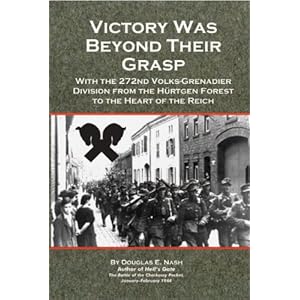
Anyone that read my old book reviews in the GI Journal knows I don't take kindly to crap. I get irritated when people publish books that are rehashes of something else, tell us nothing new, or show the author clearly does not have a good grasp on the subject.
Thus I bring up Victory was Beyond Their Grasp, by Doug Nash.
So this book makes me angry. Not because it's bad- heavens no. It's good. Van Johnson good! It makes me angry that something like this which breaks such new ground, on a topic no one else has done any real work on gets pretty much ignored.
While someone like Rick Atkinson who doesn't know a WW2 battalion from a regiment, gets massive royalties and $100,000 awards from the Pritzker Military Library. Life is just not fair.
So to be brief, this is an important book. It's the only one in English I am aware of that deals with the company history of a Volks-Grenadier Company in the Hurtgen Forest and on. It belong in every military history library, and the author deserves a major award for doing something new, interesting, important, and good.
Another fine book from the Aberjona Press - which if you don't know their stuff you need to!
Storage
I have no storage space left. None. Zip. Zilch.
This means most of my collection is stored and not displayed. Yeah, lucky me.
So in my Nth reorganization I find that I have stuff I totally forgot I had. Which is kind of scary since I have been going through the Alzheimer's thing with my mom.
What this means is that some things have been packed away for a long time. In fact I have been in the house for almost 20 years now. There are boxes that I know I have not opened since the move (OK, those are pretty much the stuff I thought was junky surplus at the time - now some of it actually worth something).
But a lot of things have just been packed up over the years and stored away. Which got me to thinking about the old adage of pack as if it's going to be there for a while.
This means don't just toss it in a box, but give it some thought: like don't pad with acidic newspaper. Now in theory you are supposed to store clothing out flat. Few of us can afford to do this. So in some cases rolling the uniforms up may be a better way that folding them (as the time and pressure may make those folds permanent).
Don't store the stuff where there's a chance it will get wet (like near a washing machine), and not where it will hit extremes of temperature (like a garage or attic).
Keep stuff together. You may think you will remember that the cables for those radios is in the second small box from the right, but one day you won't. I have a jeep part that had all the nuts and bolts safely put into a jar so they would not get lost. And now, they are. In the jar (I hope) somewhere. Lost in the depths of the garage of doom or the basement of diet-Pepsi.
Somewhere there is a guy who has a list of everything he owns, and it tells him what box it is in. I'm not that guy. I used to know in my mind where everything was, where I got it, and what it was worth. But now I find time has let some of that slip.
So take it from me - start good collecting habits now.
This means most of my collection is stored and not displayed. Yeah, lucky me.
So in my Nth reorganization I find that I have stuff I totally forgot I had. Which is kind of scary since I have been going through the Alzheimer's thing with my mom.
What this means is that some things have been packed away for a long time. In fact I have been in the house for almost 20 years now. There are boxes that I know I have not opened since the move (OK, those are pretty much the stuff I thought was junky surplus at the time - now some of it actually worth something).
But a lot of things have just been packed up over the years and stored away. Which got me to thinking about the old adage of pack as if it's going to be there for a while.
This means don't just toss it in a box, but give it some thought: like don't pad with acidic newspaper. Now in theory you are supposed to store clothing out flat. Few of us can afford to do this. So in some cases rolling the uniforms up may be a better way that folding them (as the time and pressure may make those folds permanent).
Don't store the stuff where there's a chance it will get wet (like near a washing machine), and not where it will hit extremes of temperature (like a garage or attic).
Keep stuff together. You may think you will remember that the cables for those radios is in the second small box from the right, but one day you won't. I have a jeep part that had all the nuts and bolts safely put into a jar so they would not get lost. And now, they are. In the jar (I hope) somewhere. Lost in the depths of the garage of doom or the basement of diet-Pepsi.
Somewhere there is a guy who has a list of everything he owns, and it tells him what box it is in. I'm not that guy. I used to know in my mind where everything was, where I got it, and what it was worth. But now I find time has let some of that slip.
So take it from me - start good collecting habits now.
Thursday, May 20, 2010
147 years later- a Medal of Honor
Lt Alonzo Cushing is going to be awarded the Medal of Honor for his battery's stand at Pickett's Charge. A noble deed. His first sergeant had already been given the award, so now they have decided (after much lobbying) to approve it for Cushing.
I have a problem with this. I in no way have anything against the guy, but it opens the door to political meddling in such awards.
There was a rule that after X years you just could not qualify for a medal. Then they went back and retroactively awarded them to folks who were possibly denied medals for racial reasons. This opens the door to other retroactive awards. Like the recent move to get a MOH for Captain Winters of 506th fame just as he had been portrayed in a movie.
I guess if I had enough money I could start up a big campaign to get my dad one- drop tons of money on congressmen, make a movie about what he did, have books written, and so on.
A while back I had a conversation with one of the guys who did the basic work on the racially awarded MOH's. He had piles of names of guys who were deserving- some being turned down for being Jewish (seriously), or having drinking problems out of combat.
The most interesting one was a guy who was at first on the list as he was thought to have been Hispanic, then when the committee found out he was half Indian, they bumped him as their mandate was to only find Hispanics to award the medal to.
I encouraged him to write a book on it (and I suggested the title "close but no cigar".
No, I think it is just too dangerous to allow these after the fact awards, with the one exception being if a guy was going to have been awarded it at the time, but the paperwork really did get lost or mis-laid or something.
Friday, May 14, 2010
What have I done?
So a few weeks ago I went a tad nuts, deciding to extend my US Army combat uniform and equipment collection to the current day. In hindsight it was probably a defense mechanism to blot out the issues I was having dealing with moving my mom to an Alzheimer's unit. I had a stash of collection money in my paypal account, and I was ready to buy. I went spending my dough as if I was developing a museum collection of 'type' objects- looking for unused stuff of different patterns and versions- not ID'd groups.
But I will say I learned a lot about modern gear I had been ignoring, and acquired a fair amount of cubic square feet of 'stuff' that is somewhat cool.
And as I said I ignored the golden rule of studying first before buying. In my defense, aside from a few regulations manuals, there is really nothing much written about this stuff (post 1990 Army gear) except for helmets. So I learned by looking, asking, and digging. I'll admit the first week I made some dumb purchases. Not really bad ones, but bought extras of stuff I now know I will never really need, or be able to sell for much. I also paid a bit too much for some things. Not a lot, but I could have gotten it cheaper.
After the first week or two of almost random shotgun buying I had figured out the rough areas I needed to fill in, and what was easily available. This is when I realized that I could have done better when I started. By week two or three I had a reasonable handle on what I was looking for and began to be much more selective. And by a month I knew what were going to be the hard bits to find – which things were dogs, and which I should snap up right away if they came on the market. These were mainly items linked to the Special Operations people. Although I refuse to pay much for a Spec Ops badged uniform as I can make one up myself that cannot be told apart from a real one. I prefer generic grunt stuff myself. And for some reason it is actually harder to find.
Of course, now I tell myself that I could have taken the same money and spent it on one or two really nice things from WW1 or WW2. At times I regret that, although I honestly do not know what I would have bought that I don't already have.
Will I regret it? I'm not sure. I learned a lot and I got a few rare items that I know will just get tougher to find in the future, but I added so many more boxes to my collection that it makes it harder to move in the basement of doom.
Monday, May 10, 2010
Nothing but Praise
One of the things I often tell people who want to write on military history is to not re-invent the wheel. There is nothing I hate more than someone doing the same old book someone else has already done. This goes double for anything related to the101st AB. There are so many interesting units out there that cry out for documentation, and we are about at the last minute for getting memories for veterans.
So I give a tip of my cap … I mean… beret… to the Office of History of the Corps of Engineers. They have recently published a book called "Nothing but Praise: a History of the 1321st Engineer General Service Regiment. It is based upon the donated papers and photographs of the commanding officer. The family should be congratulated in finding such a place to give them to, as the result is a pretty good tribute to the officers and men of this little known unit.
The 3121st was a black unit with white officers in the ETO. It was one of many such generic engineer units that probably would have gone without notice had this book not been written. Spike Lee. Here's a story you could have done that would have not been such an embarrassment.
One of the things that really struck me was that unlike WW1, the WW2 general service units were pretty well equipped. In WW1 they were little more than labor battalions with pick and shovel. In the 1940's the US Army did not do anything by hand that could be done faster in a mechanized way. These guys used bulldozers, steam shovels, trucks, pneumatic hammers, rock crushers, and so on. The thing you might not get at first is this meant these guys (often poor black men from the south that had little chance for education) were suddenly given training on how to operate and maintain these things. They learned valuable skills that would transfer directly into civilian like (note Mauldin's "You're lucky, you're learning a trade").
I don't think anyone has really looked at what kind of impact this training, which probably would have never been within the grasp of many of these men, had after the war. At the very least I would like to see a survey of the jobs and skills listed for these men upon induction, and then when they were discharged. Perhaps there is a way to see how many of them went into a similar field in civilian life (Maybe check obituaries?). Here's a readymade thesis or dissertation topic for you (or a really cool book).
As for this one my main complaint it that is it too short. It's a small format softcover much like the local history books we see nowadays. The photos are great, and there is a hint here are many, many more that could have been shown. A negative point is they "design" the book a bit too much to include things like a photo of a compass, when I would prefer to see another photo of one of the men. Even if they decided not to add in more text (and I would suggest a capsule mention of all the similar units at the end, or a good T/O&E) they could have just made the pages larger and thus made the photos bigger. Of course, this is just what I would wish, and if wishes were horses we'd all be eating steak.
So I'm quite pleased that the engineer folks did this book. Especially Michael J. Broadhead who edited the work. It is things like this that make it worthwhile donating material to government organizations. For sale from the USGPO, but also at Amazon: Nothing but Praise, by Aldo H. Bagnulo, Government Printing Office, 2009, 978-0-16-083672-5.
It is a $12 book, and it can be found on Amazon.com
But you can download a free copy of it at the Corps of Engineers website. It did take me a while to actually find the durn thing, so here you go.
For more info on the book: http://www.usace.army.mil/History/hv/Pages/112-AfricanAmericanEngineer.aspx
Subscribe to:
Posts (Atom)